

Harness Engineering: The Missing Reliability Layer in Agentic AI Systems

1. The Reliability Gap🔗
Modern agentic AI systems rarely fail because the model is unintelligent. They fail because nothing governs how that intelligence interacts with real software systems.
When we deploy Large Language Models (LLMs) into production, we expose a fundamental mismatch: forcing probabilistic computation into systems built for strict determinism. Classical software engineering relies on predictability. Foundation models, however, are statistical inference engines. When autonomous loops plan actions and use tools recursively, the execution paths explode, making traditional unit testing impossible.
Initially, the industry relied on prompt engineering to bridge this gap. But prompt engineering improves reasoning, not execution. You cannot prompt your way out of a network timeout or a malformed API request.
To deploy autonomous agents at scale without risking system instability or runaway costs, we must stop trying to optimize the model's inputs. Instead, we must strictly govern its execution environment.
2. A Production Scenario🔗
To understand the cost of ungoverned intelligence, consider a flight booking agent deployed without strict boundaries. A customer asks the agent to book a flight for their upcoming trip.
The agent parses the request, searches for flights, and prepares to call the external payment API. However, it hallucinates a small detail: it generates an invalid payment payload, passing a string ("500") instead of an integer (500) for the price field.
Without a runtime harness: The agent fires the malformed payload directly at the payment API. The API rejects it, throwing a 400 Bad Request. The agent reads the raw, unformatted stack trace, gets confused by the noise, and simply retries the exact same string payload. The loop repeats. Costs increase, the session state corrupts, and the system crashes, leaving the user stranded.
With a runtime harness: The agent proposes the exact same invalid payment payload. But before the API is called, the runtime harness intercepts the request. The harness runs a fast JSON Schema validation check, which immediately fails.
The harness blocks the execution. It formats a clean, programmatic error (Field 'price' must be an integer, received string) and returns it directly to the agent. The agent reads the explicit feedback, corrects the payload to an integer, and proposes it again. The validation passes, the API is called safely, and the execution succeeds.
This is the difference between an ungoverned prototype and a dependable production system.
3. What is Harness Engineering?🔗
Harness Engineering is the engineering discipline of designing deterministic runtime systems around probabilistic AI models.
It is a new discipline that treats the AI model not as a trusted executor of logic, but as an untrusted, highly variable component requiring strict containment. By shifting our focus from prompt optimization to execution governance, Harness Engineering helps ensure that systems remain stable despite the inherent unpredictability of the underlying models.
The architectural core of this discipline is the strict separation of reasoning and execution. In this model, the reasoning engine, typically an LLM, acts purely as a stateless planner. Its sole responsibility is to evaluate the current context and propose the next logical action.
The reasoning engine is restricted from directly mutating system state, executing code, querying databases, or interacting with external APIs. It can only propose actions.
The runtime harness handles the actual execution. It serves as a deterministic software layer that manages context windows, sanitizes state mutations, executes tools within secure sandboxes, and handles system-level errors. The harness intercepts every action proposed by the reasoning engine, validating it against strict, pre-defined criteria.
Prompt Engineering vs. Harness Engineering
| Feature | Prompt Engineering | Harness Engineering |
|---|---|---|
| Control Mechanism | Natural language instructions | Deterministic code boundaries |
| Execution Phase | Pre-inference (Input context) | Post-inference (Runtime intercepts) |
| Failure Handling | Prompt adjustments & retries | Circuit breakers & state rollbacks |
| Security Posture | Vulnerable to prompt injection | Isolated sandboxing & HITL gates |
| State Management | Relies on LLM attention span | Explicit persistence checkpointers |
Key Insight
Prompt Engineering influences reasoning.
Harness Engineering governs execution.
Core Principle
The goal is not deterministic models.
The goal is deterministic systems.
We accept that foundation models will hallucinate, drift, and make mistakes. Harness Engineering helps ensure that regardless of what the model proposes, execution predictably follows explicit, verifiable rules. Probabilistic anomalies are caught at the boundary, preventing them from translating into infrastructure failures.
4. Reference Architecture🔗
To operationalize these concepts, we construct a framework-agnostic reference architecture for a seven-layer Agentic AI Runtime Harness.
This architecture operates as an interceptor middleware pattern. It sits directly between the Orchestration Engine, the LLM Reasoning Core, and the external Tool Registry.
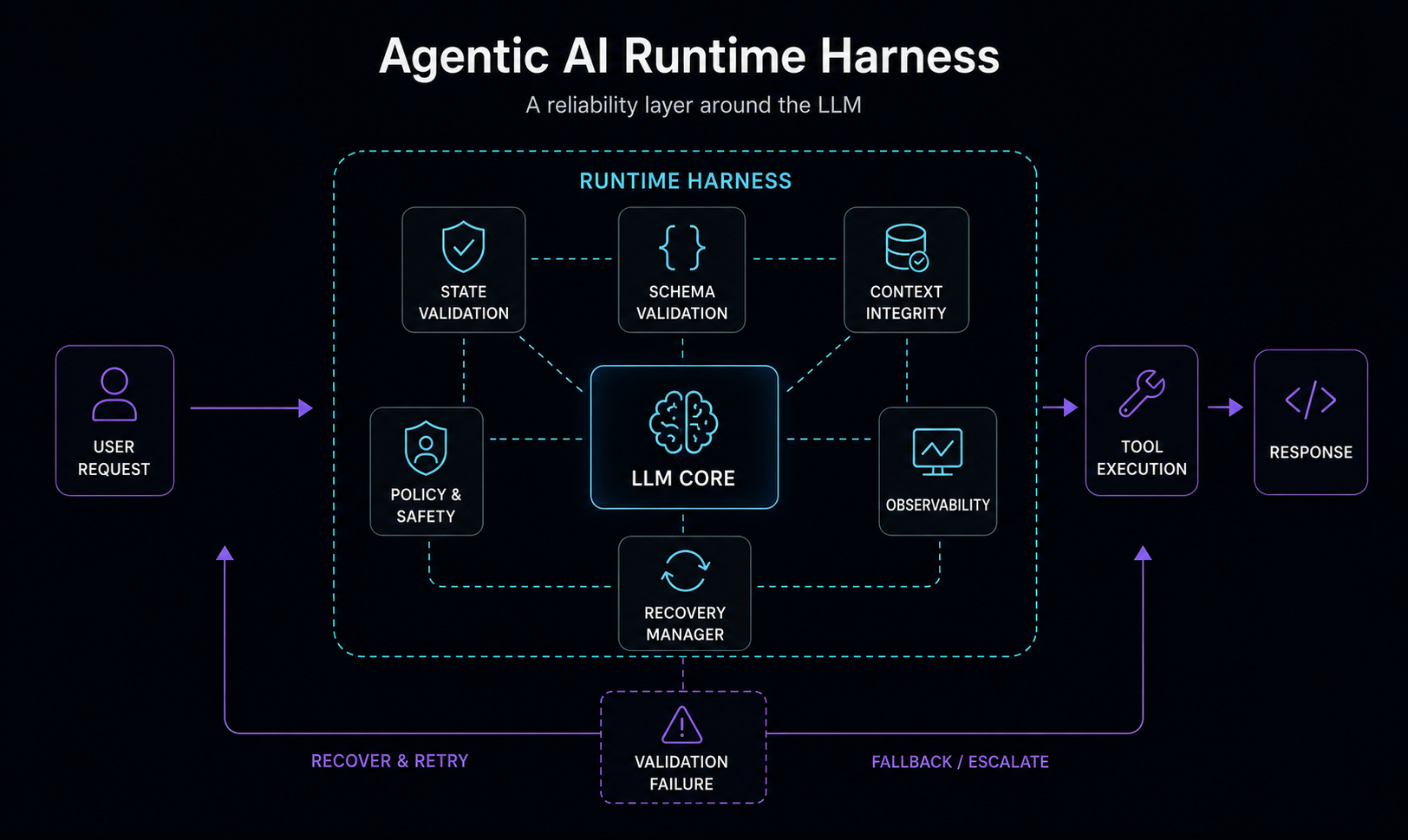 Agentic AI Runtime Harness Architecture
In this architecture, requests flow through each layer sequentially. Every layer serves a distinct purpose: it either enriches context, validates payloads, constrains behavior, executes code, or observes the system state. Together, these layers transform an unpredictable LLM into a dependable, production-grade system.
4.1 Input Guardrail
This layer serves as the initial security gate. It intercepts user queries and incoming environmental context before any interaction with the foundation model occurs. It runs fast policy checks and heuristic analysis to block prompt injections, jailbreak attempts, and obvious policy violations. This prevents malicious or malformed inputs from reaching the reasoning engine.
4.2 Context & Memory Manager
Operating as the state orchestrator, this layer manages the prompt payload. It intercepts reads and writes to memory, actively optimizing the context window. It summarizes historical turns and prunes stale tool outputs. It is responsible for assembling the most relevant, token-efficient prompt payload for the current execution step, keeping the LLM focused on the immediate task.
4.3 LLM Reasoning Core
This is the central processing node where the foundation model resides. In this architecture, we treat it strictly as a stateless, isolated reasoning engine. It receives the curated context from the layer above, reasons over the problem space, and proposes the next step. Its output is treated strictly as a proposal, either a final text response or a structured tool request, rather than a direct, executable command.
4.4 Inline Guardrail
Operating immediately after the model's output generation, this layer intercepts the LLM's proposed tool invocation. It performs rigorous schema validations, structural correctness checks, and type enforcement. If validation fails, the guardrail actively blocks the request. It formats a detailed error message describing the exact schema violation and sends it back to the reasoning core for an automated self-repair attempt.
4.5 HITL Gate
This acts as a serialized interrupt gate designed specifically for privileged operations. If the validated tool call is flagged by policy as high-risk or irreversible, such as executing a financial transaction, execution suspends. State checkpointers persist the current workflow context, and the harness awaits explicit human sign-off via an external interface before allowing the action to proceed.
4.6 Execution Sandbox
This is the deterministic workspace where verified and approved tool calls are executed. Using isolated runtime slots, often orchestrated via protocols like MCP or containerized environments, this layer ensures the execution of untrusted agent output remains fully contained. It provides strong isolation to prevent dynamically generated code from impacting the underlying host system or leaking state across tenant boundaries.
4.7 Audit & Trace Ledger
Functioning as an asynchronous observability sink spanning the entire runtime harness, this layer captures structured telemetry logs of every execution. It rigorously records processing latencies, token consumption, precise state mutations, and all validation decisions. This ledger is critical for maintaining strict audit compliance and continuously evaluating the operational reliability of the agentic system.
5. Core Principles🔗
To design a production-grade runtime harness, systems engineers must adhere to five core architectural principles.
Isolation
Definition: Isolation requires that stochastic planners operate without direct access to host resources, containing all tool executions within ephemeral sandboxes.
Why it matters: It limits the security blast radius of erratic agent logic and prevents unintended interactions with the broader infrastructure.
Failure it prevents: This principle prevents compromised reasoning engines from corrupting host filesystems or exfiltrating sensitive data from internal networks.
Contract-Driven Execution
Definition: Contract-driven execution requires every state change proposed by the agent to pass a strict schema validation check before being committed.
Why it matters: It forces the agent to adhere to explicit data structures and provides programmatic error feedback when it deviates from the contract.
Failure it prevents: This principle prevents the agent from writing invalid parameter types that would crash downstream databases or APIs.
Fail-Safe Recovery
Definition: Fail-safe recovery implements bounded retry budgets and state rollback mechanisms rather than allowing agents to iterate indefinitely.
Why it matters: It provides a predictable fallback path when the agent encounters reasoning dead-ends or repeated schema violations.
Failure it prevents: This principle prevents runaway execution loops, ensuring that unrecoverable errors do not result in infinite billing cycles.
Observability
Definition: Observability requires every step of the agent's execution to be traceable, structured, and logged in a central ledger.
Why it matters: Agentic systems are inherently non-deterministic, making deep visibility into prompt inputs, validation results, and token usage essential for debugging.
Failure it prevents: This principle prevents silent failures, allowing engineers to identify specific performance bottlenecks and state corruption issues.
Separation of Privilege
Definition: Separation of privilege ensures that credentials and access tokens are managed exclusively by the runtime harness, not by the agent.
Why it matters: The agent receives abstract tool definitions, while the actual injection of API keys occurs securely during the execution phase.
Failure it prevents: This principle prevents the LLM from inadvertently leaking API keys in conversational output or exporting credentials via prompt injection.
6. Runtime Building Blocks🔗
A dependable runtime harness implements these principles through several modular subsystems, each designed to address specific failure modes within the execution loop.
| Component | Prevents | Why It Matters |
|---|---|---|
| Context Manager | Context Drift | Keeps reasoning focused and token costs low |
| Validation Filter | Invalid Tool Calls | Protects downstream systems from malformed payloads |
| Checkpointer | State Loss | Enables reliable error recovery and time-travel debugging |
| HITL Gate | Unsafe Actions | Ensures human oversight for irreversible operations |
| Execution Sandbox | Host Compromise | Provides secure, isolated code execution |
| Circuit Breaker | Infinite Loops | Controls infrastructure costs and halts runaway tasks |
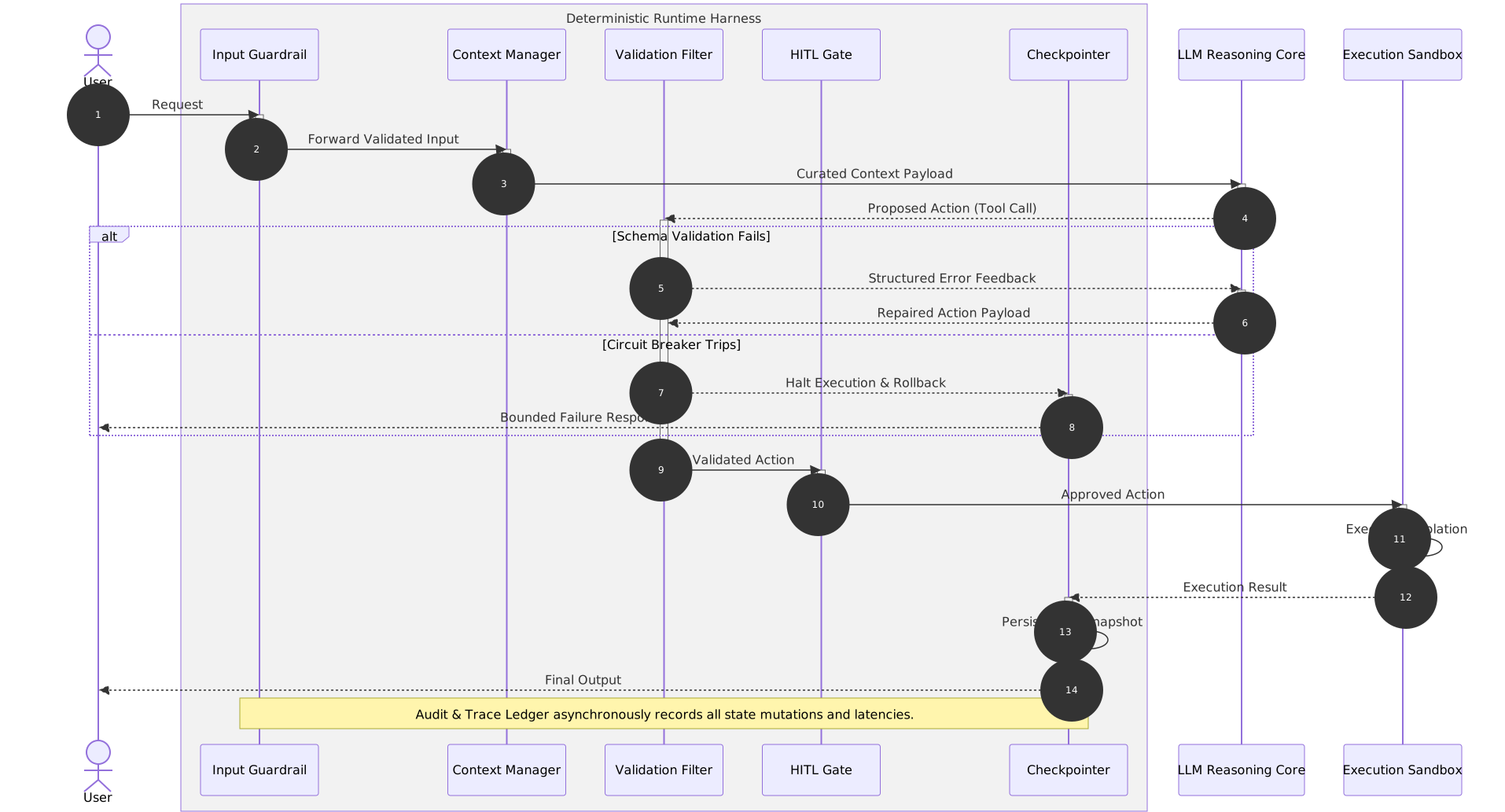 Runtime Harness Execution Flow
Context Manager
The Context Manager is responsible for actively pruning and structuring the working memory supplied to the reasoning engine. In production, this often involves sliding window algorithms, token-aware truncation, and hybrid search to inject high-signal knowledge. By keeping the context window clean, it significantly reduces inference latency while improving reasoning accuracy.
Validation Filter
The Validation Filter is an interceptor that verifies proposed tool invocations against strict structural contracts before execution. Modern runtime harnesses implement this using strict parsing libraries like Pydantic or Zod to enforce grammar rules. By enforcing these contracts, it protects external APIs and downstream pipelines from crashing due to hallucinated parameters or malformed payloads.
Checkpointer
The Checkpointer takes immutable snapshots of the working memory and execution graph after each validated step. Production implementations typically rely on event sourcing patterns, recording every state mutation as a discrete event. If a subsequent step fails unrecoverably, the runtime harness leverages these logs to roll back the state, enabling non-linear task resumption without expensive workflow restarts.
HITL Gate
The Human-In-The-Loop (HITL) Gate serves as a serialized interrupt mechanism for privileged operations. It intercepts high-risk requests, suspends the execution loop, and waits for cryptographic sign-off via an operator interface. This provides a necessary compliance safeguard, ensuring that irreversible actions like financial transactions require explicit human approval.
Execution Sandbox
The Execution Sandbox provides a contained, deterministic workspace for untrusted tool calls and generated code. Enterprise architectures achieve this isolation using boundary controls like gVisor for containers, eBPF filters, or lightweight WebAssembly (Wasm) modules. This protects the host operating system, allowing the safe execution of dynamic logic in multi-tenant environments.
Circuit Breaker
The Circuit Breaker monitors the execution loop to enforce operational thresholds based on token usage, execution duration, and consecutive validation failures. Built using token bucket algorithms or rate limiters, it instantly terminates the agent loop if these thresholds are breached. This controls infrastructure costs and ensures poorly performing tasks fail gracefully.
7. Production Considerations🔗
While these building blocks provide the foundation, designing and operating a production-grade runtime harness requires engineers to balance rigid safety constraints with performance efficiency.
Latency vs. Validation
Every validation layer, schema guard, and sandbox spin-up introduces latency into the critical path. To maintain a responsive user experience, these steps must be optimized using fast, deterministic validators rather than slower "evaluator" LLMs. Furthermore, system architectures should decouple asynchronous checks from blocking ones. Running input guardrails, data anonymization policies, and context assembly concurrently using non-blocking I/O routines minimizes the time to first byte and keeps the execution loop fluid.
Cost Control
To prevent runaway execution loops from generating massive API bills, establishing strict token and financial budgets is essential. The runtime harness must enforce workload-specific limits on the number of loop iterations per request. Distributed tracing systems should aggregate token consumption across all spawned sub-agents in real-time. If the agent fails to reach a verifiable solution within this budget, the circuit breaker must suspend the loop, returning a semantic failure message to prevent unbounded billing spikes.
Sandbox Lifecycle
Spinning up fully isolated virtual machines for every tool call is secure but computationally slow, introducing overhead for fast-paced workflows. In high-throughput environments, engineers can balance this by using pre-warmed pool workers. Alternatively, leveraging lightweight WebAssembly (Wasm) runtimes provides an isolated memory space with sub-millisecond instantiation times, effectively balancing security with low-latency API requirements.
Recovery Strategy
When a tool call fails schema validation, the runtime harness must employ a bounded self-correction protocol. It should catch the exception, format it into a structured payload, and return it to the model for a repair attempt. However, this repair loop must have configurable operational thresholds. If the model cannot successfully correct the payload within its bounded retry budget, the runtime harness should fall back to a previous checkpoint or escalate to a human operator.
8. Conclusion🔗
The first generation of AI engineering focused on making models smarter. The next generation must focus on making systems dependable.
Harness Engineering marks a structural shift from treating foundation models as unpredictable black boxes to actively managing them as components within disciplined, deterministic systems.
Building a resilient runtime harness is no longer an optional safety measure; it is the foundational infrastructure required to make agentic systems truly ready for the enterprise.
In the long run, the success of autonomous agents will depend less on the sheer intelligence of the model, and entirely on the resilience of the harness that governs it.