
State Engineering: Designing Agent State Systems That Don't Pollute

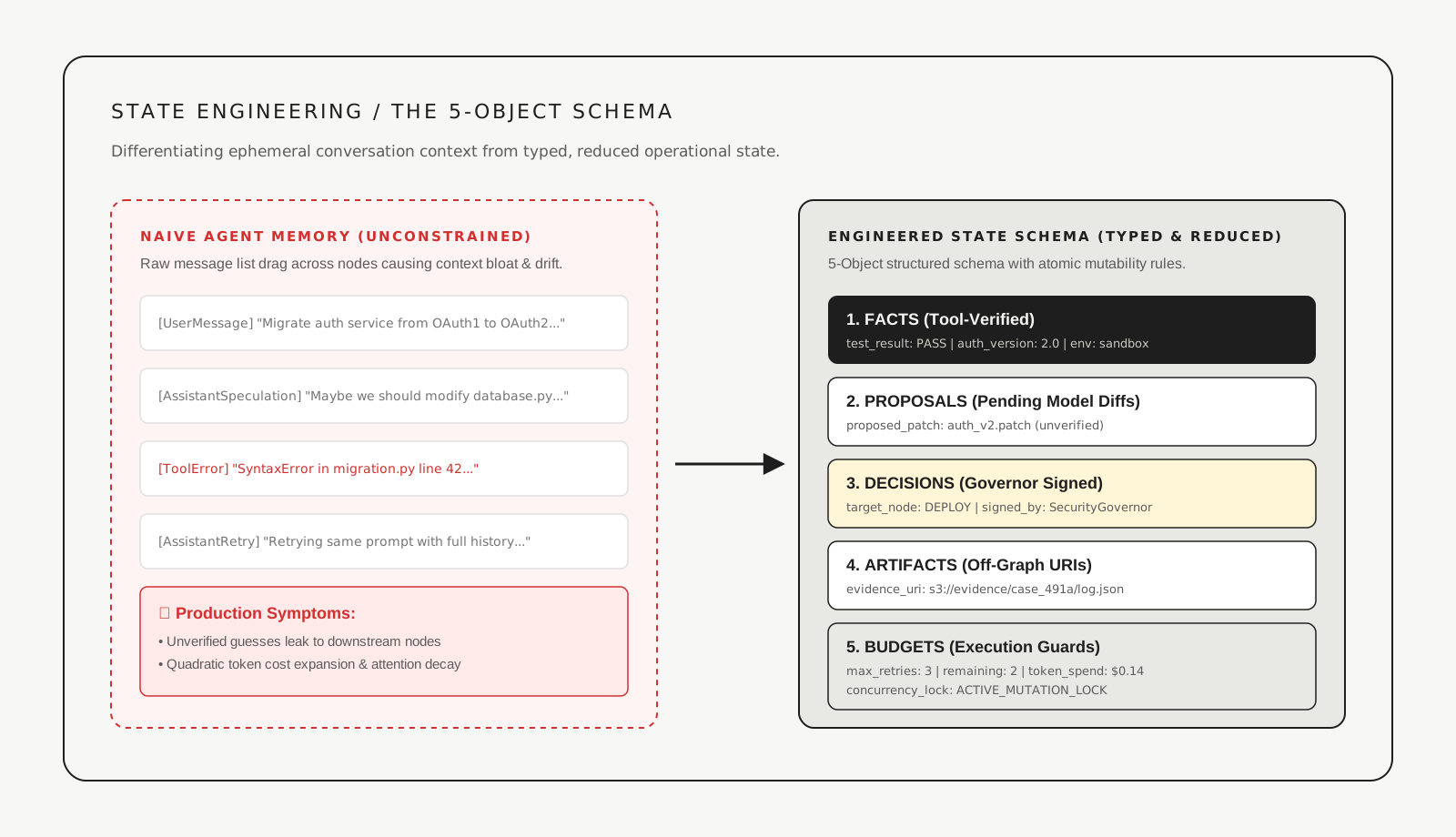 State Engineering — a 5-object typed schema and state reduction architecture
One agent can fix a single function. A swarm of agents can overwrite each other's memory, drag megabytes of irrelevant conversation across nodes, and report success on a broken build.
That is the state gap.
As agent systems grow from single loops to multi-agent graphs, the primary point of failure shifts. It is rarely a failure of model intelligence. It is almost always a failure of state management: an unverified hypothesis from a research node leaking into global memory, a parallel reviewer overwriting an implementation diff, or an agent spending half its token budget re-reading its own scratchpad.
Loop engineering designs how a unit of work converges.
Graph engineering designs how many units of work coordinate.
State Engineering designs how work units shape, scope, mutate, and isolate shared operational data.
Without state engineering, a multi-agent graph is merely a distributed system with no type safety, no variable scoping, and unconstrained shared memory.
1. Conversation History Is Not Agent State🔗
The most common design flaw in early agentic systems is collapsing conversation history into the definition of "state."
Developers pass the raw message list ([UserMessage, AssistantMessage, ToolMessage, ...]) from node to node, assuming that because the model can read previous messages, it has a state.
Naive State (Unconstrained Context Window):
[System Prompt] → [User Request] → [Model Thought] → [Tool Call] → [Observation] → [Model Speculation] → [Retry...]
This creates three immediate production bottlenecks:
- Context Pollution: Speculative reasoning, abandoned attempts, and verbose tool outputs remain in the context window. Downstream nodes mistake an unverified model guess from five turns ago for a confirmed fact.
- Context Decay & Quadratic Cost: Every node re-processes every historical token. Latency scales non-linearly, and token costs explode while reasoning quality degrades due to attention dilution.
- Missing Structure: A message list cannot enforce type constraints, schema invariants, remaining execution budgets, or atomic state locks.
State is not a log of what was said. State is a typed schema of what is true, what is pending, what is decided, and what remains to be done.
Engineered State (Typed Operational Schema):
┌────────────────────────────────────────────────────────┐
│ FACTS       : Provenance-tracked, tool-verified observations │
│ PROPOSALS   : Model-generated diffs or candidate plans │
│ DECISIONS   : Signed transitions approved by a Governor│
│ ARTIFACTS   : Immutable pointers (S3 URIs, Git SHAs)  │
│ BUDGETS     : Remaining retries, token caps, step limits│
└────────────────────────────────────────────────────────┘
2. The Five Failure Modes of Unengineered State🔗
When state is treated as an untyped global dictionary or raw text string, multi-agent graphs fail in five predictable ways:
| Failure Mode | Structural Cause | Production Symptom |
|---|---|---|
| Speculative Pollution | A node writes unverified hypotheses to global state | Downstream implementer writes code based on an unconfirmed research guess |
| Mutation Race | Parallel nodes write to shared state keys without locks | Interleaved responses corrupt data, causing silent state loss |
| Context Leakage | Local loop scratchpads are appended to global memory | Reasoning context bloats, driving up latency and attention drift |
| Non-Idempotent Replay | Resuming a process re-executes state mutations | Retry loops trigger duplicate payment calls or redundant database writes |
| Schema Drift | Nodes emit loose, unvalidated JSON key-value updates | Runtime KeyError crashes when downstream handlers parse unexpected fields |
State engineering provides the structural boundaries, typed interfaces, and mutation rules required to eliminate these failure modes.
3. The Five Objects of a Production State Schema🔗
A production state schema separates operational data into five distinct objects, each carrying explicit mutability and scope rules:
3.1 Facts (Immutable, Tool-Verified)
Facts are observations generated by deterministic tools, tests, or environment checks. They carry provenance (timestamp, tool identifier, execution status). Once appended to the state, a Fact cannot be modified by a model; it can only be superseded by a newer verified observation.
3.2 Proposals (Transient, Model-Generated)
Proposals represent candidate solutions: a proposed code diff, a draft plan, or an unverified claim. Proposals exist in a pending state until an evaluator or verification node validates them.
3.3 Decisions (Signed Transitions)
Decisions represent accepted system milestones—such as a passed test suite, an approved security review, or a human approval gate. Decisions must be signed by an authoritative node or Governor before the workflow transitions to a terminal state.
3.4 Artifacts (Off-Graph Immutable Pointers)
Heavy payloads—such as large source trees, build binaries, or multi-megabyte log files—should never sit directly inside the LLM context state. The state schema stores lightweight, immutable handles (e.g. S3 URIs or Git commit hashes). Nodes read and write to the underlying storage using these pointers.
3.5 Budgets (Operational Counters & Guardrails)
Budgets track remaining execution capacity: maximum allowed retries, token spend limits, step timeouts, and active concurrency locks. When a budget counter reaches zero, the state engine triggers an escalation route regardless of model output.
4. Production Patterns from Real-World Runtimes🔗
High-throughput, real-time AI platforms enforce state discipline through explicit architectural patterns:
Pattern A: State Machines & Concurrency Locks
In real-time platforms like Hermes AI, voice sessions and LLM reasoning steps move through an explicit state machine (from idle to listening, processing, speaking, and disconnected).
To prevent audio frame ingestion and model generation tasks from mutating session state simultaneously, transitions are executed under atomic concurrency locks. Precondition state guards verify that an operation is valid before execution begins, emitting structured transition logs on every state change.
Pattern B: State Ledger vs. Immutable Evidence Store
In high-stakes decision systems like Aegis AI, state is decoupled into two tiers:
- A Lightweight State Ledger: A fast database table tracking status enums, confidence scores, user IDs, and append-only audit histories.
- An Immutable Evidence Store: Raw, multi-page reasoning evidence and full tool payloads are persisted to an S3 evidence bucket.
Nodes pass lightweight state objects containing evidence URIs across the graph. This keeps handoffs fast and context windows lean while maintaining full auditability.
Pattern C: State-Aware Infrastructure Protection
In enterprise retrieval platforms like Athena, state extends to infrastructure readiness. Circuit breakers monitor service health states (closed, open, half-open) to prevent degraded LLM or vector database endpoints from accepting new requests, failing fast before an agent loop consumes token budget on failing dependencies.
5. State Reducers: The Boundary Pipeline🔗
State should never be updated through direct variable assignment (state.x = y). Direct assignment obscures change history, breaks time-travel debugging, and allows invalid data to contaminate the system.
Instead, production state engines use Reducers combined with Type Validation at the Boundary:
  Node Output (Raw Model Intent)
               │
               ▼
┌──────────────────────────────┐
│  Boundary Validation Layer   │ ──[Invalid Schema]──► Trigger Local Repair
│   (Pydantic / Zod Contracts) │
└──────────────┬───────────────┘
               │ [Valid Delta]
               ▼
┌──────────────────────────────┐
│    Atomic Reducer Function   │ ──► Compute State Delta
└──────────────┬───────────────┘
               │
               ▼
┌──────────────────────────────┐
│    Updated State Ledger      │ ──► Commit Immutable Log Event
└──────────────────────────────┘
- Boundary Validation: When a node finishes execution, its output payload is validated against a strict schema contract (such as a Pydantic model). If the schema fails validation, the state engine rejects the update and routes back for a local repair turn.
- Delta Generation: Validated outputs are emitted as discrete delta commands describing the change, rather than an overwritten state object.
- Atomic Reduction: A deterministic reducer function receives the current state and the delta command, returning a new, immutable state version.
6. State Topology and Scoping Rules🔗
To prevent context bloat and memory contamination across complex graphs, state must be scoped across three visual layers:
┌─────────────────────────────────────────────────────────────┐
│ GLOBAL GRAPH STATE                                          │
│ (System Goal, Final Artifact Handles, Global Budgets, Status)│
│                                                             │
│   ┌─────────────────────────────────────────────────────┐   │
│   │ LOCAL LOOP MEMORY (Node-Isolated)                   │   │
│   │ (Scratchpad, Sandboxed Test Diffs, Intermediate Logs)│   │
│   └──────────────────────────┬──────────────────────────┘   │
│                              │                              │
│                              ▼                              │
│               [EDGE HANDOFF PAYLOAD ONLY]                   │
│                              │                              │
│   ┌──────────────────────────┴──────────────────────────┐   │
│   │ LOCAL LOOP MEMORY (Next Node)                       │   │
│   └─────────────────────────────────────────────────────┘   │
└─────────────────────────────────────────────────────────────┘
- Global Graph State: Accessible by the overall orchestrator and Governor. Contains terminal decisions, verified artifact URIs, global budget counters, and top-level goals.
- Local Loop Memory: Isolated to a single node or local iteration loop (e.g. an implementer running sandbox tests). When the local loop terminates, its transient scratchpad memory is discarded or summarized—it does not bleed into the global graph.
- Edge Handoff Payloads: The precise, minimal subset of state defined by an edge contract to pass from Node A to Node B.
7. Checkpointing and Time-Travel Debugging🔗
For long-running tasks, state must survive process restarts, deployments, and temporary API outages.
Delta Checkpointing vs. Snapshotting
Storing full state snapshots at every graph step creates unnecessary storage overhead. Production state systems record an append-only event log. The system can reconstruct the exact state at step $N$ by replaying the event stream through its reducers.
Idempotency Requirements
When a system resumes from a checkpoint after a crash, re-running a node must not re-execute non-idempotent operations (such as charging a credit card or creating a duplicate ticket).
The state engine tracks idempotency keys for every executed tool call inside the state ledger. If a replayed step requests an action whose idempotency key exists in the ledger, the engine returns the stored result without re-executing the underlying tool.
8. The State Engineering Checklist🔗
Before deploying a multi-agent system to production, evaluate your state architecture against this checklist:
- Type Safety: Are all state payloads defined using explicit schemas (Pydantic / Zod) rather than untyped dictionaries?
- History Separation: Is raw conversation history separated from operational state (facts, decisions, budgets)?
- Off-Graph Artifacts: Are heavy payloads (code trees, logs, images) stored off-graph with lightweight URI handles in state?
- Atomic Reducers: Are state updates processed through deterministic reducer functions instead of direct property assignment?
- Memory Scoping: Is local scratchpad memory isolated to its local loop, preventing leakage into global graph state?
- State Machine Enums: Are system statuses governed by explicit state enums with precondition guards?
- Idempotent Replays: Does the state engine track tool execution idempotency keys for safe checkpoint resumes?
9. Reliability Is a Function of State Discipline🔗
Prompting determines what a model might attempt. Harness engineering constrains what a single execution can touch. Loop engineering ensures local convergence. Graph engineering defines the topology of coordination.
State Engineering provides the mathematical backbone for all of them.
When state is typed, scoped, reduced, and provenance-tracked, multi-agent systems stop drifting. They become inspectable, reproducible software systems that execute complex goals with predictable control.